
Steel Structure Fabrication 101: How Steel Buildings, Towers and Bridges Are Made

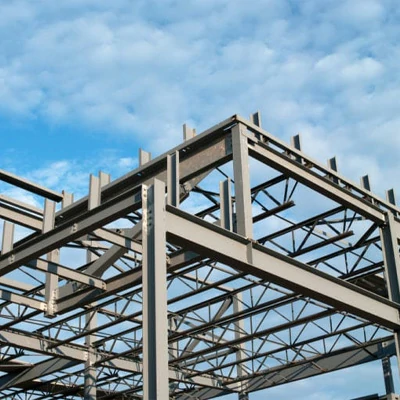
Steel Structure Fabrication 101: How Steel Buildings, Towers and Bridges Are Made
Steel structures surround us — from the frames of high-rise buildings and factories to transmission towers, bridges, and stadium roofs. But how do raw steel plates and sections become a precise, load-bearing structure that fits together on site within millimetres? The answer lies in a disciplined industrial process called steel structure fabrication. This guide explains the materials, the steps, and the quality controls that turn steel into safe, durable structures.
What Is Steel Structure Fabrication?
Steel structure fabrication is the process of cutting, shaping, drilling, assembling, and welding raw steel into the individual components — beams, columns, trusses, braces, and connections — that make up a building or industrial structure. Fabrication is performed in a controlled workshop environment to tight tolerances, after which the components are transported to site for erection.
This discipline is what allows steel buildings to be erected far faster than site-cast concrete, because the “kit of parts” is manufactured off-site to exact dimensions and simply assembled on arrival.
Why Engineers Build With Steel
Steel offers a combination of properties no other structural material matches. Its strength-to-weight ratio is exceptionally high, so it can span long distances with relatively light members. It is ductile — it bends and warns before it fails — a crucial safety property in earthquakes and extreme loads. It is dimensionally precise, arrives ready to assemble, and is 100% recyclable.
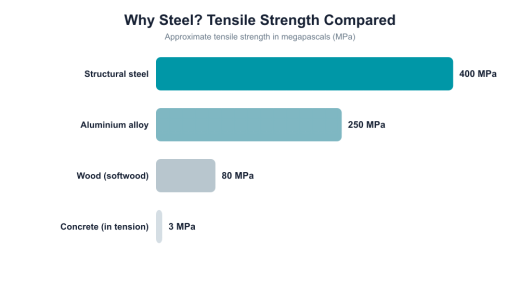
Steel’s high tensile strength sets it apart from concrete, aluminium, and wood.
Most important, steel carries tension as well as compression — something concrete struggles to do without heavy reinforcement. This makes steel the natural choice for long spans, tall towers, and any structure that must resist wind, seismic, and impact loads.
From Design to Shop Drawings
Fabrication begins long before any steel is cut. Structural engineers produce a design model, which is then developed into detailed shop drawings and 3D models (often using BIM and Tekla software) showing every member, connection, and bolt hole. Modern fabricators drive computer numerical control (CNC) machinery directly from these models, so a dimension in the digital model becomes a precise cut on the shop floor. This digital thread — from design to machine — is what makes modern steel fabrication so accurate.
Common Steel Grades and Materials
The workhorse material for structural fabrication is carbon structural steel. In Europe, grades such as S235, S275, and S355 are common, with the number indicating the minimum yield strength in megapascals — S355, for example, yields at 355 MPa. In North America, ASTM A36 and higher-strength grades such as A572 serve the same role. High-strength low-alloy (HSLA) steels offer greater strength for lighter members, while stainless and weathering steels are chosen where corrosion resistance is critical.
The grade selected affects weldability, strength, and cost, so engineers match the material to the load, the environment, and the fabrication process — and every batch arrives with a mill certificate confirming its chemistry and mechanical properties.
The Fabrication Process, Step by Step
- Material inspection — verifying steel grade, dimensions, and mill certificates against the drawings.
- Cutting — CNC saws, plasma, and laser cutters cut plates and sections to length and shape.
- Drilling and punching — bolt holes are produced to precise positions, often on CNC drilling lines.
- Assembly (fit-up) — components are positioned and tack-welded into their final geometry.
- Welding — joints are welded by qualified welders to documented welding procedures.
- Surface treatment — blast cleaning followed by galvanizing or painting for corrosion protection.
- Inspection and delivery — dimensional checks, weld inspection, marking, and shipping to site.
Welding and Quality Control
Welding is the heart of steel fabrication and the most rigorously controlled step. Fabricators use qualified welding procedure specifications (WPS) and welders certified to standards such as ISO 9606. Inspections include visual checks, dimensional verification against tolerances (often within a few millimetres), and non-destructive testing such as ultrasonic or magnetic-particle examination of critical welds. A quality management system such as ISO 9001:2015 ties these controls together, ensuring every batch is traceable from raw material to finished component.
Protecting Steel: The Galvanizing Connection
Even the best fabrication is wasted if the steel rusts. That is why many fabricators pair fabrication with hot-dip galvanizing — dipping the finished components in molten zinc to create a corrosion-resistant coating that lasts for decades. Galvanizing after fabrication is especially effective because the coating protects cut edges, weld zones, and hollow sections uniformly.
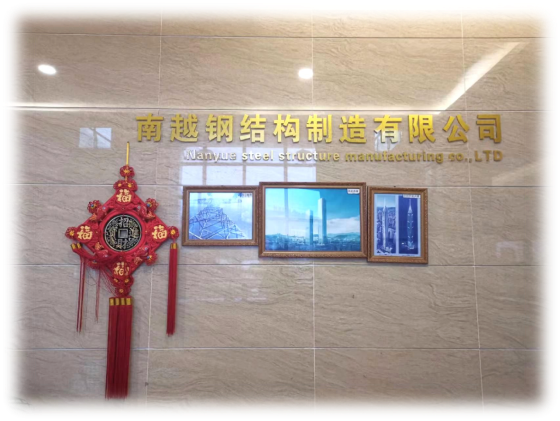
Fabricated steel structures at Nanyue Steel Structure Manufacturing Co., Ltd. (Guangdong, China).
For outdoor structures such as towers, guardrails, and light poles, fabrication plus galvanizing is a complete, low-maintenance solution that protects the full service life of the asset.
Common Types of Steel Structures
Fabricators produce many structural forms. Rigid frames form the skeletons of industrial buildings and warehouses. Trusses use triangular arrangements of members to span long distances efficiently. Transmission towers and microwave towers are lattice structures assembled from angle sections and plates. Curved and special-shaped steel structures — increasingly common in modern architecture — are produced by bending and cutting plate to complex geometries. Each type demands different fabrication techniques, from rolling and bending to CNC profile cutting.
Applications Across Industries
Steel structures are everywhere. In power and communications, transmission towers and microwave towers. In transport infrastructure, bridges, highway guardrails, and airport structures. In construction, industrial workshop frames, warehouse roofs, and stadium roofs. In maritime, shipbuilding iron parts and port structures. Whatever the sector, the common thread is the same: steel fabricated to precise tolerances, then protected for decades of service.
Frequently Asked Questions
What is the difference between fabrication and erection?
Fabrication is the workshop process of making the steel components; erection is assembling those components on site. Fabrication controls geometry; erection controls assembly sequence and temporary stability.
How accurate is steel fabrication?
Modern CNC fabrication routinely achieves tolerances of ±1 to ±2 mm on member lengths and hole positions, which is why steel frames fit together so cleanly on site.
Can any shape be fabricated?
Almost any geometry can be produced, including single-curved and double-curved members, using bending, rolling, and CNC cutting. The limit is usually cost, not capability.
How is fabrication quality verified?
Through material certificates, qualified welders and procedures, dimensional inspection, non-destructive testing, and full traceability under a quality management system.
How long does a steel structure last?
Properly designed, fabricated, and galvanized steel structures routinely achieve design lives of 50 years or more, with many older structures still in service after a century. The limiting factor is usually corrosion protection rather than the steel itself.
Is steel fabrication environmentally friendly?
Yes. Steel is the world’s most recycled material, and 100% of structural steel can be recycled without loss of quality. Fabrication is precise, generates little waste, and galvanized coatings extend service life further, reducing resource use over the long term.
Conclusion
Steel structure fabrication is where engineering precision meets heavy industry. By turning digital models into accurately cut, welded, and protected components, fabricators give builders a material that is fast to erect, safe in service, and recyclable at end of life. When fabrication is combined with hot-dip galvanizing, the result is a structure built to last for generations — with the maintenance burden of a material that simply refuses to rust.